Comparison guide
BPD vs. autism
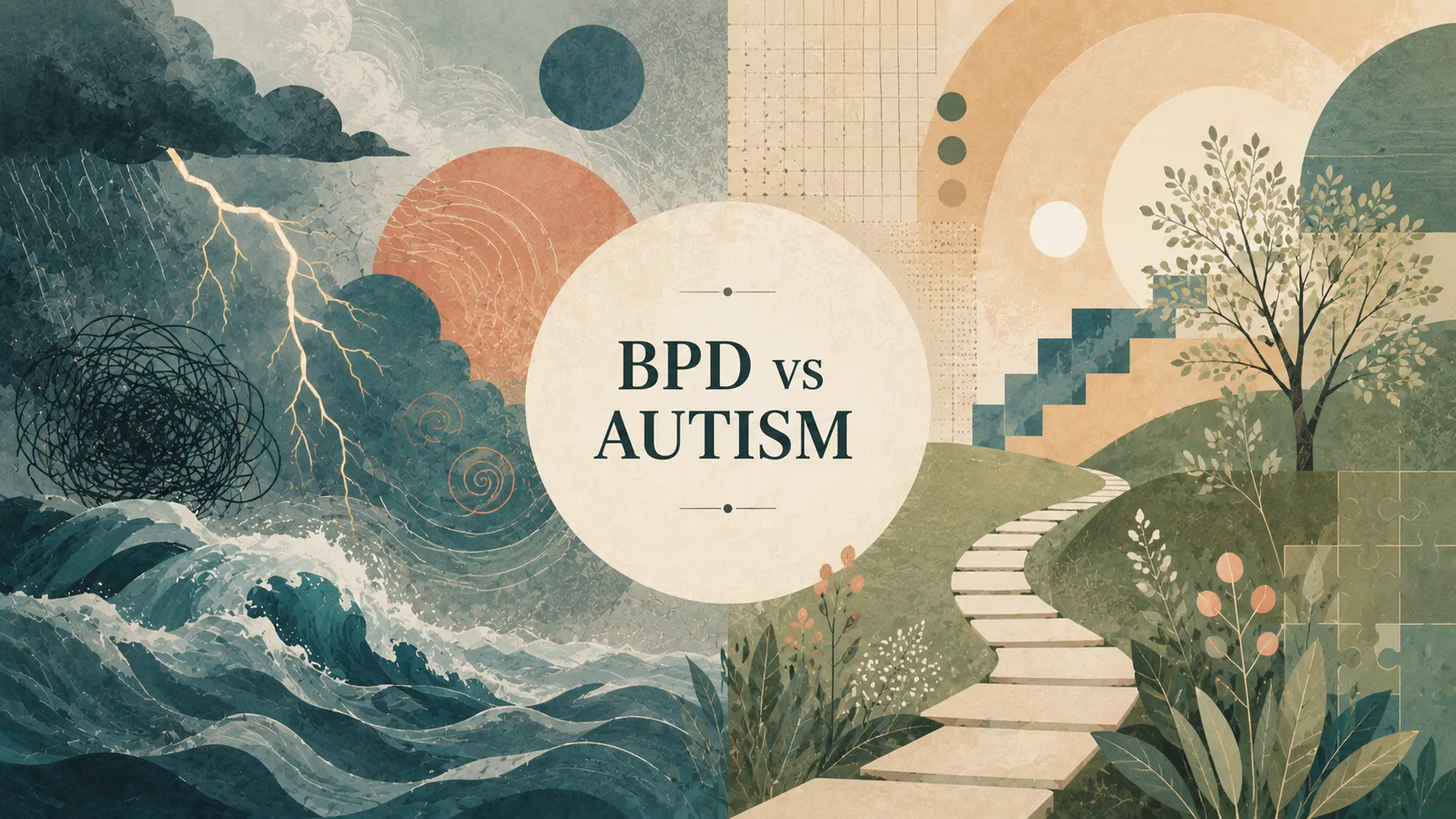
Borderline personality disorder and autism can both involve social difficulty, intense emotion, sensory overwhelm, misunderstandings, and a need for predictability. They are not the same. Autism is a neurodevelopmental difference; BPD is a mental-health condition. Some people may be autistic, have BPD, have both, or have another explanation for what they are experiencing.
What autism is centred on
Autism spectrum disorder is a developmental disability associated with differences in social communication and interaction, along with restricted or repetitive behaviours, interests, or needs for sameness. Autistic people may also have sensory differences and different ways of learning, moving, communicating, or paying attention. These traits begin in development, though some people are not recognised or assessed until adolescence or adulthood.
Autism is highly varied. Eye contact, speech, employment, relationships, intelligence, or outward confidence do not determine whether someone is autistic. An assessment looks at a person's developmental history, current experiences, strengths, support needs, and how traits show up over time and in different settings.
What BPD is centred on
BPD can involve a persistent pattern of emotional instability, difficulties in close relationships, fear of abandonment, an unstable sense of self, impulsive behaviour, emptiness, anger, and stress-related dissociation or mistrust. For some people, distress is especially tied to perceived rejection, conflict, or uncertainty in relationships. BPD is assessed through a clinical history and interview; it is not identified by being socially anxious, needing routines, or having sensory sensitivities.
These descriptions can overlap at the surface. An autistic person may shut down after sensory or social overload. A person with BPD may withdraw after a conflict or fear of rejection. A clinician needs to ask what happened beforehand, what the experience means to the person, how long it has been present, and what other patterns are involved.
Why overlap can be confusing
Both autistic people and people with BPD may find relationships difficult, feel misunderstood, struggle after social stress, experience strong emotions, or have a history of being excluded or invalidated. Some people mask their distress so effectively that it is missed by others. Women, gender-diverse people, and people from under-recognised groups may face particular diagnostic delays or be given explanations that do not fit their experience.
Research reviews confirm overlap in some clinical features but also emphasise that the evidence base is limited and heterogeneous. A systematic review and meta-analysis found that the available studies could not establish whether one condition is commonly misdiagnosed as the other. That uncertainty is a reason for careful, respectful assessment—not a reason to assume that every autistic person with emotional distress has BPD.
Developmental history matters
One of the most useful areas to explore is early development. Autism-related traits are developmental: a clinician may ask about childhood communication, friendships, play, sensory experiences, routines, interests, school reports, and how the person understood social situations long before a current relationship crisis. An adult assessment can be harder when those records are unavailable, but it can still be possible.
For BPD, clinicians explore longer-term patterns in emotion regulation, identity, relationships, impulsivity, safety, and stress-related experiences. They also consider trauma, anxiety, depression, ADHD, OCD, and other factors. Early adversity may be relevant to a person's story but does not diagnose BPD, and autism does not result from trauma.
Sensory overload, shutdowns, and emotional crises
Sensory overload or a sudden change in routine can be intensely distressing for an autistic person. They may need less stimulation, clear communication, time to recover, or predictable support. A shutdown or meltdown is not a manipulation tactic and should not automatically be interpreted as a BPD crisis.
Likewise, intense emotional distress in BPD should not be dismissed as attention-seeking. Some people may experience both sensory overload and relationship-triggered distress. A useful care plan listens to the person about triggers, warning signs, what helps, and what makes things worse, rather than forcing every response into one explanation.
Can someone be autistic and have BPD?
Yes, dual diagnosis is possible, although research has not yet resolved all questions about its frequency and clinical presentation. If a person has both, care may need to account for autistic communication and sensory needs as well as emotional regulation, relationships, safety, and any trauma-related symptoms. A provider should adapt communication and treatment rather than assuming a standard approach works for everyone.
You are allowed to ask whether a clinician has experience assessing autistic adults or adolescents, and how they distinguish developmental traits from symptoms that began later. Seeking a second opinion can be reasonable if an assessment relies on stereotypes or does not listen to your developmental history.
What to do next
Bring specific examples to an assessment: childhood traits, sensory experiences, social misunderstandings, relationship patterns, periods of distress, shutdowns, self-harm thoughts, sleep, and what support helps. You do not need to decide which label fits before seeking help. You can say, "I have lifelong social and sensory differences, and I am also struggling emotionally. I want a careful assessment."
Ask for accommodations that make an appointment easier: clear written information, extra processing time, a quieter room, remote options where available, or permission to bring a trusted person. Needing an accessible assessment is not evidence for or against any diagnosis; it is a practical way to make sure your experience is understood accurately.
Read how BPD assessment works and use our resources page to find support. If you may act on thoughts of self-harm or suicide, use urgent support now rather than waiting for an assessment.
If you’re in crisis or thinking about harming yourself
You deserve support right now. If there is immediate danger, call your local emergency number or go to the nearest emergency department.
- United States: call or text 988, or visit 988 Lifeline.
- United States: text HOME to 741741 to reach Crisis Text Line.
- UK & Ireland: call 116 123 to reach Samaritans.
- Elsewhere: use Findahelpline.com to find a local support line.